Why 3D Printing Education Matters
Learn 3D printing. Explore additive manufacturing. Discover the skills shaping tomorrow’s workforce.
Welcome to 3DEMart, an educational resource for students, teachers, schools, career seekers and anyone interested in learning about 3D printing and additive manufacturing.
3D printing has grown far beyond desktop machines making simple plastic objects. Additive manufacturing is being explored and used across engineering, aerospace, automotive manufacturing, healthcare, architecture, product development, research and education.
As these technologies advance, education becomes increasingly important.
Students need opportunities to understand how products move from an idea on a computer screen to a physical object. Teachers need practical resources for bringing 3D printing into classrooms. Schools need help understanding equipment, software, materials and curriculum options. People entering the workforce need to understand the skills employers are looking for.
That’s where 3DEMart begins.
Our goal is to explore 3D printing education from the classroom to the workplace—and help more people discover the opportunities being created by additive manufacturing.
What Is 3D Printing?
3D printing is a method of creating physical objects from digital designs.
Instead of cutting material away from a larger block, many 3D printing technologies build objects by adding material layer by layer. That’s why 3D printing is commonly associated with the broader field of additive manufacturing.
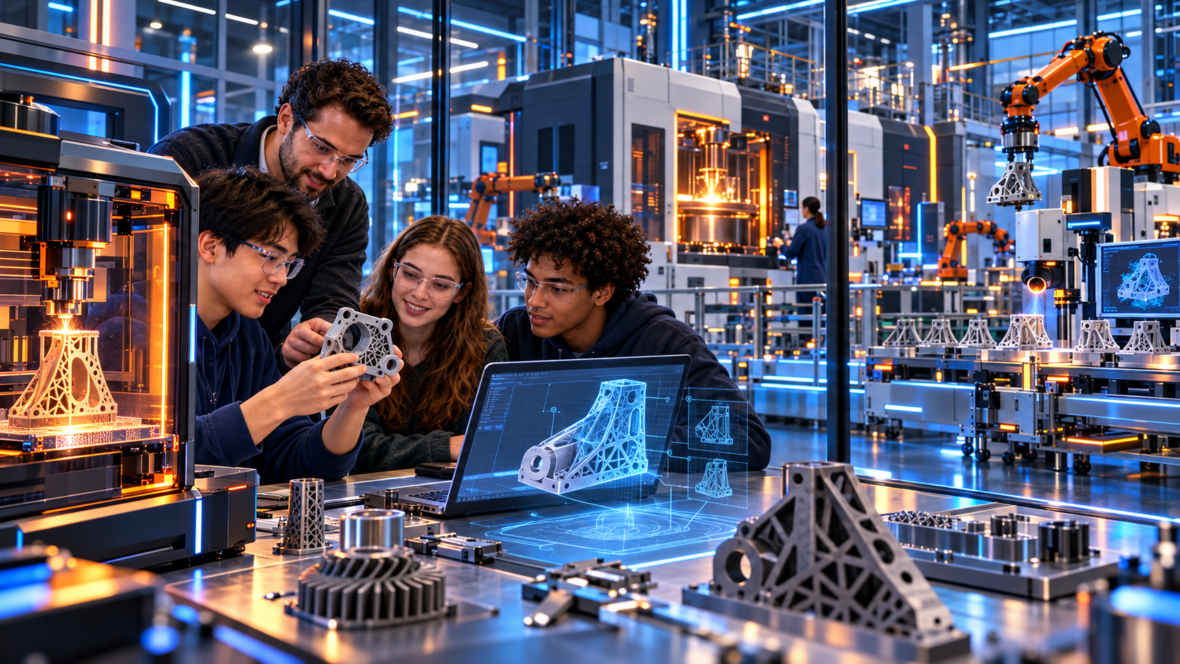
A student can design an object using computer-aided design software, send that design to a 3D printer and watch a physical version of the idea take shape.
That connection between designing, making, testing and improving is one reason 3D printing can be such an interesting educational tool.
Why 3D Printing Education Matters
Learning 3D printing isn’t only about learning how to operate a printer.
A successful project can introduce students to several valuable skills at once:
Computer-aided design
Students learn how ideas can be transformed into digital 3D models.
Engineering
Designing printable objects encourages students to think about dimensions, strength, structure and function.
Manufacturing
Students gain firsthand experience with how digital designs become physical products.
Problem Solving
A print that doesn’t work isn’t necessarily a failure. It creates an opportunity to identify what went wrong, modify the design and try again.
Creativity
Students can move from consuming technology to actually creating with it.
These skills can connect 3D printing with STEM education, engineering, robotics, manufacturing, art, architecture and entrepreneurship.
Bringing 3D Printing Into Schools
Imagine a classroom where students don’t just draw an invention.
They build it.
A science class could create physical models.
Engineering students could design and test prototypes.
Robotics teams could manufacture custom components.
Art students could explore digital sculpture.
Entrepreneurship students could design products and calculate what they cost to manufacture.
History students could recreate artifacts and structures.
3D printing can become more than a separate technology class. It can become a tool used across multiple subjects.
That’s why 3DEMart is exploring ways schools can develop practical 3D printing and additive manufacturing programs.
Explore 3D Printing Educational Programs
Students interested in additive manufacturing may want to continue learning beyond high school.
Universities, community colleges, technical schools and specialized training programs are increasingly important parts of the additive-manufacturing ecosystem.
Programs may combine subjects such as mechanical engineering, materials science, computer-aided design, manufacturing and additive technologies.
Explore our guide to 3D printing educational programs to discover examples of educational opportunities related to this growing field.
From the Classroom to a 3D Printing Career
Education becomes especially powerful when students understand where their skills could take them.
Additive manufacturing involves much more than someone standing beside a printer.
The industry can involve:
CAD designers
Mechanical engineers
Materials specialists
Manufacturing engineers
Machine technicians
Software developers
Researchers
Quality-control specialists
Product designers
Biomedical researchers
Applications engineers
Learning about these possibilities can help students connect classroom projects with real career paths.
Explore our Top 50 3D Printing Employers to see the types of organizations involved in additive manufacturing.
3D Printing and Advanced Manufacturing
Desktop 3D printers are a useful introduction, but additive manufacturing extends much further.
Industrial systems can work with polymers, metals, ceramics and other materials using a variety of manufacturing processes.
Engineers are investigating and using additive manufacturing for applications ranging from lightweight aerospace components to customized medical devices.
For students, this creates an important connection.
The small printer sitting in a classroom can introduce some of the same fundamental ideas behind much larger advanced-manufacturing systems:
Design digitally.
Build additively.
Test the result.
Improve the design.
That cycle can teach students how modern products are developed.
Learning Through Hands-On Projects
One of the strongest aspects of 3D printing education is that students can see the results of their decisions.
Suppose a student designs a bridge.
Instead of simply viewing the bridge on a computer screen, the student can print the design and test it.
Does it support the expected weight?
Did a section break?
Could less material be used?
Could the structure be redesigned?
The student can modify the digital model and print another version.
This creates a powerful educational cycle:
Imagine → Design → Print → Test → Improve
That’s engineering thinking in action.
3D Printing and Entrepreneurship
3D printing education can also introduce students to entrepreneurship.
A student with an idea for a product can potentially create a digital model, produce a prototype and test the concept without immediately investing in conventional manufacturing equipment.
Students can learn questions that every manufacturer and entrepreneur eventually faces:
How much material does the product require?
How long does it take to manufacture?
What does each unit cost?
Can the design be improved?
Would someone buy it?
Can it be customized?
How could production be scaled?
That makes 3D printing useful not only for STEM education but also for teaching innovation and business development.
Exploring 3D Bioprinting
Some of the most fascinating applications of 3D printing are happening at the intersection of engineering and biology.
3D bioprinting investigates methods of positioning biological materials and cells into carefully designed three-dimensional structures.
Researchers are exploring applications involving tissue models, drug testing, regenerative medicine and other areas of biomedical research.
The field remains an active area of scientific development, but it demonstrates how far the fundamental idea of controlled three-dimensional printing can potentially extend.
3DEMart follows developments in 3D bioprinting and printed organs as part of our coverage of the future of additive technologies.
What About 3D Printed Food?
Another emerging field is 3D food printing.
Instead of printing plastic or metal, food-printing systems can deposit edible materials according to digital designs.
Researchers and developers have experimented with chocolate, dough, purees, plant-based ingredients and other printable foods.
This creates interesting questions involving food manufacturing, customized nutrition, alternative proteins and automated food production.
For students, 3D food printing is another example of how engineering can intersect with completely different fields.
What Students Can Learn From 3D Printing
Perhaps the greatest educational value of 3D printing isn’t the printer itself.
It’s the process.
Students start with a problem.
They imagine a solution.
They create a digital design.
They manufacture the object.
They test it.
Then they discover something almost every engineer already knows:
The first design usually isn’t the final design.
They make changes and try again.
That experience can help develop curiosity, persistence, creativity and practical problem-solving skills.
Building the Next Generation of Makers and Manufacturers
Manufacturing is becoming increasingly digital.
Design software, robotics, automation, artificial intelligence and additive manufacturing are changing how products can be developed and produced.
Tomorrow’s engineers, technicians, designers, researchers and entrepreneurs are sitting in classrooms today.
Giving students opportunities to experiment with technologies such as 3D printing can help them understand what’s possible.
A student who prints a simple object today might eventually design an aerospace component.
Another might develop medical technology.
Another could become a manufacturing engineer.
Another could start a company.
And another might invent an application nobody has considered yet.
Explore 3D Printing With 3DEMart
3DEMart is building a resource for anyone interested in understanding where 3D printing education can lead.
We’ll continue exploring:
3D printing in schools
Additive manufacturing education
3D printing educational programs
3D printing careers and employers
CAD and digital design
Printers and printing technologies
3D printing materials
Classroom projects
Advanced manufacturing
3D bioprinting
3D printed food
Emerging applications of additive manufacturing
Whether you’re a student considering a career, an educator investigating classroom technology or simply someone curious about the future of manufacturing, there’s a place to begin.
Start by exploring our 3D printing educational programs and our guide to 3D printing employers.
Start Learning About the Future of Manufacturing
3D printing gives students something particularly valuable:
the ability to turn an idea into something they can hold in their hands.
But the real opportunity is bigger than the object coming off the printer.
It’s learning how to design, experiment, solve problems and create.
Those skills can follow students far beyond the classroom.
3DEMart is here to help students, educators and future innovators explore 3D printing—and discover where additive manufacturing could take them next.